
09 September 2026
QR IBAN & QR Reference: Your Guide for Swiss Self-Employed
Mastering the QR IBAN and QR Reference (QRR) is crucial for Swiss freelancers and SMEs. This guide explains how to leverage them for efficient invoicing and accounting.
Simplify Your Freelance Business with QR IBAN and QR Reference
As an artisan or self-employed professional in Switzerland, efficient invoicing and timely payments are cornerstones of your success. The introduction of the Swiss QR-bill, with its comprehensive QR code, has significantly streamlined payment processing. At the heart of this digital shift are two key components: the QR IBAN and the QR Reference (QRR). You might be wondering how they work and how to integrate them into your workflow for smoother transactions and valuable time savings. This guide will provide clear, practical answers.
Understanding QR IBAN: The New Standard for Your Incoming Payments
The QR IBAN is a specific bank identifier used exclusively in conjunction with a QR Reference (QRR) on the QR-bill. Unlike a traditional IBAN, which can be used with a Creditor Reference (SCOR) or no reference at all, the QR IBAN is designed for structured, automated payment processing. The issuer identification (IID) within a QR IBAN falls between the 5th and 9th positions and ranges from 30000 to 31999.
For you, as an artisan or freelancer, this translates into faster and more accurate incoming payments. Imagine fewer instances of incorrect transfers or incomplete payment descriptions requiring manual reconciliation. The automated transmission of banking data ensures funds reach the correct account more securely and efficiently. Whether you're a builder, electrician, consultant, or any other service provider, adopting the QR IBAN within your QR-bills is a simple yet powerful step to optimise your cash flow.
The QR Reference (QRR): Your Invoice's Unique Identifier
The QR Reference (QRR) is a 27-digit sequence, including a check digit. It must be exclusively linked to a QR IBAN and serves to connect a specific payment to its corresponding invoice. For example, a carpenter can generate a unique QRR for each quote issued. When you receive your bank statement in camt.054 format, this reference allows for automatic identification of the matching invoice.
If your current invoicing system uses a standard IBAN and places the invoice number in the free communication field, it's not generating a structured QRR or SCOR reference. In such cases, the IBAN typically won't be converted to a QR IBAN. It's essential to review your bank's requirements and the capabilities of your invoicing software. As a starting point, verify that the visible details on the invoice (beneficiary, account, amount, currency) match what your client's banking app reads. A successful scan doesn't guarantee the transfer; always confirm receipt of funds separately.
Integrating QR IBAN and QRR into Your Workflow
For Swiss artisans and SMEs, integrating these elements is more straightforward than it might seem, especially with the right invoicing software. Here are the fundamental steps:
- **Automatic Generation:** Your invoicing software automatically generates the complete QR-bill, including your bank's QR IBAN and a unique QR Reference for each document.
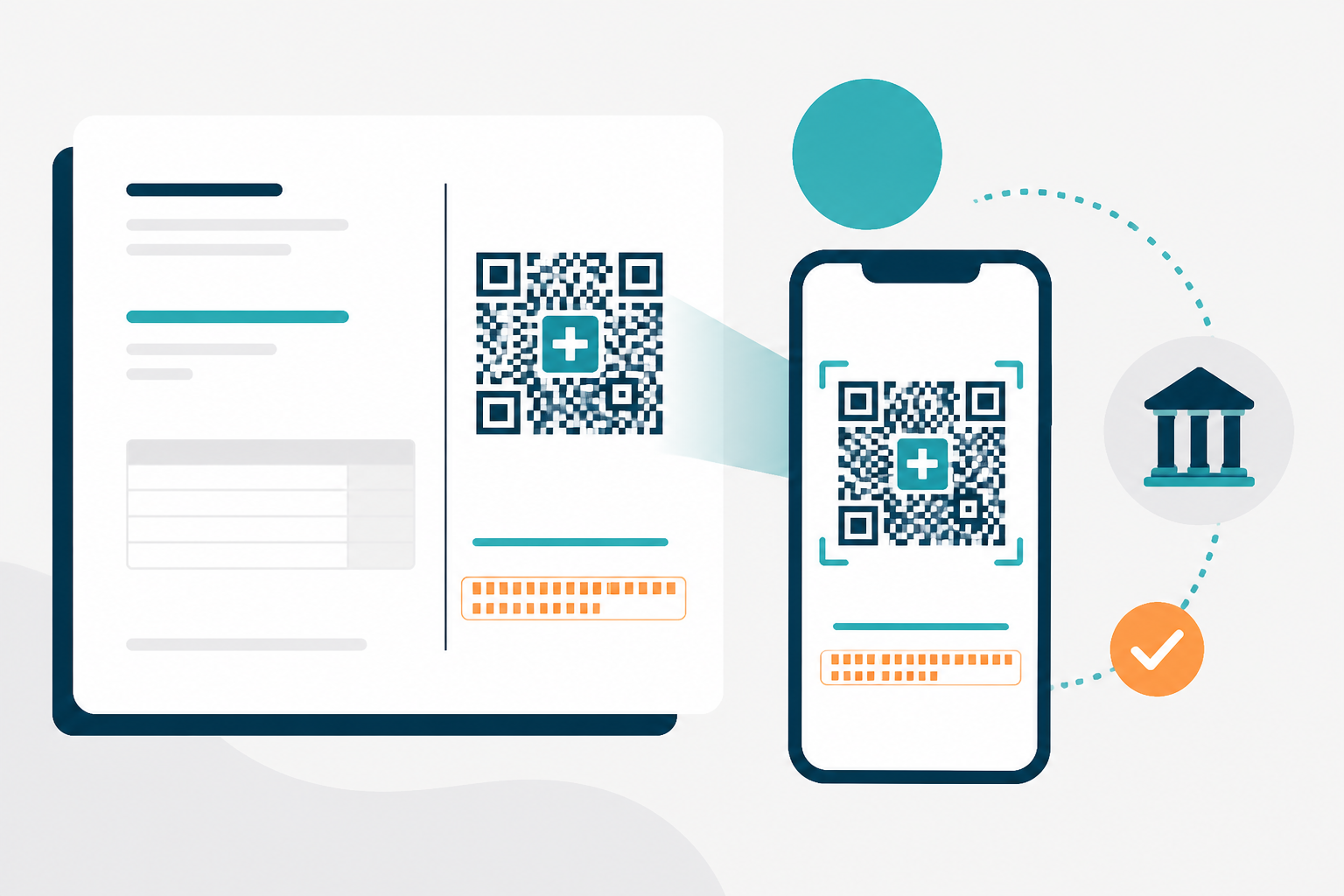
- **Client Transmission:** Send the invoice (digital or printed) to your client. They can pay by scanning the QR code with their banking app or a scanner.
- **Reconciliation:** Upon receiving your bank statement (camt.053 or camt.054 file), the software automatically matches payments to open invoices thanks to the QR Reference. Software like Pratiko handles this seamlessly, even with the Free plan for the first 5 monthly documents.
The goal is to minimise manual intervention. By automating QR-bill generation, you save time and reduce errors. A client receiving a clear invoice with an easy-to-scan QR code is more likely to pay promptly. For instance, an art restorer in Lugano can ensure clients settle invoices on time, even if they are based in another canton.
Tangible Benefits for Your Business
Utilising the QR IBAN and QR Reference significantly simplifies your administrative processes. For a self-employed professional like yourself, this means less time spent on bookkeeping and more time dedicated to your craft. It also enhances your business's image, portraying it as modern and organised. Compliance with Swiss standards, such as the QR-bill, is vital to avoid complications with banks or authorities. Remember that interest on late payments is legally mandated (Art. 104 CO) at 5% annually, and accurate payment management helps enforce this correctly.
Streamline Your Invoicing Today
Discover our comprehensive guide to creating your Swiss QR-bills.
What distinguishes a QR IBAN from a standard IBAN?
A standard IBAN is your regular bank account number. In Switzerland, it begins with 'CH' followed by 19 digits. A QR IBAN is a specialised variant for the QR-bill. It features the Issuer Identification (IID) between the 5th and 9th positions (30000-31999) and must always be accompanied by a QR Reference (QRR).
Is the QR Reference mandatory?
Yes, the use of a QR Reference (QRR) is mandatory when you use a QR IBAN on a QR-bill. A standard IBAN can be used without a reference or with a Creditor Reference (SCOR), but it does not enable the same level of automated payment reconciliation.
What are the advantages of the QR-bill for an artisan?
The QR-bill simplifies payment collection for artisans through automated reconciliation via the QR Reference. This reduces manual errors and frees up valuable time. Furthermore, it presents a modern, digital image of the business, making it easier for clients to pay using banking apps.
FAQ
- What distinguishes a QR IBAN from a standard IBAN?
- A standard IBAN is your regular bank account number. The QR IBAN is a specific variant for Swiss QR-bills, containing an Issuer Identification (IID) between positions 5-9 (30000-31999) and must always be used with a QR Reference (QRR).
- Is the QR Reference mandatory?
- Yes, when using a QR IBAN on a QR-bill, the QR Reference (QRR) is mandatory for structured payment processing and automated reconciliation. A standard IBAN can be used differently.
- What are the benefits of the QR-bill for a Swiss artisan?
- The QR-bill streamlines payment collection for artisans through automated reconciliation via the QR Reference. This reduces errors, saves time, and projects a modern business image, simplifying payments for clients.
- How does Pratiko help with QR IBAN and QR Reference?
- Pratiko software automatically generates QR-bills with the correct QR IBAN and QR Reference. It also facilitates seamless payment reconciliation using camt.053/054 files, significantly simplifying administrative tasks for freelancers and SMEs.
Related articles
- Swiss QR-bill errors: fix IBAN, addresses and printingAvoid rejected QR payments: check your IBAN and reference type, address details and PDF print settings. A practical checklist for Swiss small businesses.
- QR-IBAN and QR reference: get Swiss invoice payments rightLearn how QR-IBAN and the 27-digit QR reference work together. Avoid mismatched payment details and make Swiss invoice reconciliation easier.
- CAMT 054 Reconciliation: Your Swiss Business GuideMaster CAMT 054 reconciliation for Swiss businesses. Streamline payment processing and save valuable time with automation.
- Einzahlungsschein to QR-Rechnung: What's ChangedSwitzerland phased out the Einzahlungsschein. Discover what changed with the QR-Rechnung for Swiss artisans and SMEs: requirements, VAT, payments, and bene